

| Author | Vladimir Lenin (as N. Lenin) |
|---|---|
| Original title | Что делать? Наболевшие вопросы нашего движения |
| Language | Russian |
| Published | 1902 |
| Part of a series on |
| Leninism |
|---|
|
|
|
Jan 20, 1989 Nikolai Chernyshevsky's 1863 novel What is to be Done? Was one of the most famous and influential books in nineteenth century Russia. Three of Dostoevsky's masterpieces – Notes from Underground, Crime and Punishment and The Devils – were, in large part, extended responses to Chernyshevsky's ideas.
- Nikolai Chernyshevsky. Nikolai Chernyshevsky, the son of a priest, was born in Saratov, Russia, in 1828. After graduating from the University of St Petersburg he taught in Saratov. Chernyshevsky became a journalist and in 1855 joined the staff of Sovremennik (The Contemporary) where he wrote about literature and politics.
- Nikolai CHERNYSHEVSKY (1828 - 1889), translated by Nathan Haskell DOLE (1852 - 1935) and Simon S. SKIDELSKY (1862 - ) Despised by Dostoyevsky and Tolstoy, What Is To Be Done? Is a fascinating, sympathetic story of idealistic revolutionaries in mid-nineteenth century tsarist Russia; translator Nathan Haskell Dole affirms in his preface his.
- What is to be Done? Vladimir Lenin First published: 1902 Transcription by: Tim Delaney This printable edition produced by: Chris Russell for the Marxists Internet Archive Please note: The text may make reference to page numbers within this document. These page numbers were maintained during the transcription process to remain faithful to the.
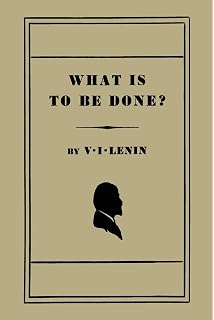
What Is to Be Done? Burning Questions of Our Movement (Russian: Что делать? Наболевшие вопросы нашего движения, tr.Chto delat'? Nabolevshiye voprosy nashevo dvizheniya) is a political pamphlet written by Russian revolutionaryVladimir Lenin (credited as N. Lenin) in 1901 and published in 1902.[1] Lenin said that the article represented 'a skeleton plan to be developed in greater detail in a pamphlet now in preparation for print.'[2] Its title is taken from the 1863 novel of the same name by the Russian revolutionary Nikolai Chernyshevsky.
In What Is to Be Done?, Lenin argues that the working class will not spontaneously become political simply by fighting economic battles with employers over wages, working hours, and the like. To educate the working class on Marxism, Lenin insists that Marxists should form a political party, or vanguard, of dedicated revolutionaries in order to spread Marxist political ideas among the workers. The pamphlet, in part, precipitated the split of the Russian Social Democratic Labor Party between Lenin's Bolsheviks and the Mensheviks.[3]
Main points[edit]
Lenin first confronts the so-called economist trend in Russian social democracy that followed the line of Eduard Bernstein. He explains that Bernstein's positions were opportunist, a point expressed by the French socialistAlexandre Millerand as in taking a post in a bourgeois government. Against the economists' demand for freedom of criticism, Lenin advances the position that the orthodox Marxists had the same right to criticize in return. He stresses that in the struggle against the bourgeoisie, revolutionary social democrats would need to pay particular attention to theoretical questions, recalling Friedrich Engels' position that there were three forms of social democratic struggle, namely political, economic and theoretical.[4]
Lenin theorizes that workers will not spontaneously become Marxists merely by fighting battles over wages with their employers. Instead, Marxists need to form a political party to publicise Marxist ideas and persuade workers to become Marxists. He goes on to argue that to understand politics you must understand all of society, not just workers and their economic struggles with their employers. To become political and to become Marxists, workers need to learn about all of society, not just their own corner of it, arguing:
Class political consciousness can be brought to the workers only from without; that is, only from outside the economic struggle, from outside the sphere of relations between workers and employers. The sphere from which alone it is possible to obtain this knowledge is the sphere of relationships (of all classes and strata) to the state and the government, the sphere of the interrelations between all classes.[5]
Reflecting on the wave of strikes in late 19th century Russia, Lenin writes that 'the history of all countries shows that the working class, exclusively by its own efforts, is able to develop only trade-union consciousness;' that is, combining into trade unions and so on. However, socialist theory in Russia, as elsewhere in Europe, was the product of the 'educated representatives of the propertied classes,' the intellectuals or 'revolutionary socialist intellectuals.' Lenin states that Karl Marx and Friedrich Engels themselves, the very founders of modern scientific socialism, belonged to this bourgeois intelligentsia.[6]
References[edit]
- ^Le Blanc, Paul. 2008. Revolution, Democracy, Socialism: Selected Writings of Lenin. London: Pluto Press. pp. 9, 128.
- ^Lenin, Vladimir (1901). 'What Is To Be Done?'. Lenin's Selected Works. Marxists Internet Archive. Retrieved 11 February 2018.
- ^Malia, Martin (1994). The Soviet Tragedy: A History of Socialism in Russia, 1917–1991. New York: Free Press. ISBN978-0-02-919795-0.
- ^North, David (6 September 2005). 'The Origins of Bolshevism and What Is To Be Done?'. World Socialist Web Site. International Committee of the Fourth International. Archived from the original on 6 June 2013. Retrieved 3 June 2013.
- ^Lenin, Vladimir (1901). 'What Is to Be Done?'. Lenin Internet Archive at Marxists Internet Archive.
- ^Le Blanc, Paul (2008). Revolution, Democracy, Socialism: Selected Writings of Lenin. London: Pluto Pres. pp. 31, 137–138.
Primary source[edit]
| Wikisource has original text related to this article: |
| Russian Wikisource has original text related to this article: |


Chernyshevsky What Is To Be Done Pdf Editor Windows 10
Lenin, Vladimir. 1901. 'What Is To Be Done?,' translated J. Fineberg and G. Hanna. Lenin Internet Archive. Marxists Internet Archive. Retrieved 5 July 2020. Available as eText.
Further reading[edit]
Ms Chernyshevsky
- T. Lih, Lars. 2006. Lenin Rediscovered: What Is to Be Done? in Context (Historical Materialism series). Leiden: Brill. Reviewed by:
- Blackledge, Paul. 3 July 2006. 'What was Done.' International Socialism 111. Retrieved 5 July 2020.
- Craig, Joe. 10 November 2006. 'Review – ‘Lenin Rediscovered: What is to be Done? In Context’.' Socialist Democracy. Retrieved 5 July 2020.
- Draper, Hal. 1990. 'The Myth of Lenin's 'Concept of The Party' or What They Did to What Is To Be Done?.' — essay contextualizingWhat Is to Be Done?.
- Sewell, Rob. 14 June 2018. 'The Revolutionary Lessons of Lenin's What is to be Done.' In Defense of Marxism. International Marxist Tendency. Retrieved 13 May 2019.
Chernyshevsky What Is To Be Done Pdf Editor File